

🎴 The Essence of Skill-Based Card Play
In this master tutorial, you will learn How to Play Spin Rummy with complete confidence. Discover how arranging cards into valid pure sequences and strategic melds turns mathematical probability into consistent table victories.
Introduction to How to Play Spin Rummy
Learning How to Play Spin Rummy unlocks one of the world’s most fascinating intellectual card games. Played across India for generations during festivals, social gatherings, and friendly club tournaments, 13-card rummy combines visual acuity, probability calculation, and deductive reasoning.
On Spin Rummy, the game is presented in a modern, streamlined digital format. Using virtual practice chips, players can explore varied table formats, practice against skilled enthusiasts nationwide, and refine their card-grouping tactics without financial anxiety.
According to standard international rules documented by the Wikipedia Rummy historical archive, rummy games share the common mechanic of matching cards of the same rank or sequence and same suit.
The Core Objective of 13-Card Rummy
In a standard game of Spin Rummy, 2 to 6 players participate using two standard 52-card decks plus printed jokers. Each participant is dealt exactly 13 cards. The fundamental objective is to arrange all 13 cards into valid combinations consisting of at least two sequences, one of which must be a Pure Sequence.
The remaining cards may be organized into impure sequences (utilizing cut or wild jokers) or valid sets (3 or 4 cards of identical rank across differing suits). A valid show requires that your total unmatched card count equals exactly 0 points.

How to Play Spin Rummy card combinations pure sequence impure sequence and valid sets
7 Winning Steps in How to Play Spin Rummy
Follow this step-by-step master roadmap on How to Play Spin Rummy effectively from deal to declaration:
- Sort Your Hand Immediately: Utilize the automated “Sort” feature to arrange your cards by alternating suits (Black-Red-Black-Red) to avoid visual confusion.
- Prioritize the Pure Sequence: Never chase sets or impure sequences until you have secured at least one consecutive 3-card pure run (e.g., 4♠-5♠-6♠) with zero jokers.
- Identify the Cut Joker: Note the randomly selected cut joker card beneath the closed deck. All cards of that identical rank act as wild cards for the hand.
- Draw Wisely: On your turn, evaluate whether the top card of the open discard pile completes a sequence, or choose the closed deck for unpredictability.
- Discard High Unconnected Cards: Eliminate unlinked Kings, Queens, and Aces early to minimize point penalties in the event of an opponent’s quick declaration.
- Build Your Second Sequence: Construct your second mandatory sequence, which may be pure or impure (employing a printed or wild cut joker).
- Verify Before Declaring: Double-check that all 13 cards form valid groups, drag your final discard card into the “Declare” slot, and submit your show.
Valid Sequences vs Sets Matrix
| Meld Classification | Composition Rule | Valid Example | Invalid Example |
|---|---|---|---|
| Pure Sequence | 3+ consecutive same suit; NO jokers | 7♥ – 8♥ – 9♥ | 7♥ – 8♥ – Joker (Impure) |
| Impure Sequence | 3+ consecutive same suit with Joker | 3♣ – 4♣ – PJ – 6♣ | 3♣ – 4♦ – Joker (Wrong suit) |
| Valid Set | 3 or 4 cards same rank; ALL different suits | K♠ – K♥ – K♦ | K♠ – K♠ – K♥ (Duplicate suit) |
Scoring System and Strategic Drop Rules
Understanding card values is crucial when mastering How to Play Spin Rummy. Cards have standardized point values:
- Face Cards (A, K, Q, J): 10 points each.
- Number Cards (2 through 10): Equal to their printed face value (e.g., 7 = 7 points).
- Printed & Cut Jokers: 0 points when grouped in sequences or sets.
- Maximum Hand Loss Cap: Capped at 80 points maximum in standard points rummy.
If dealt an unplayable hand without jokers or connected cards, use the First Drop (20 penalty points) before picking a card, or the Middle Drop (40 penalty points) if dropping after at least one turn. For comprehensive mathematical breakdowns, consult our Spin Rummy Points Calculation guide.
Advanced Tactical Tips for Social Tables
To elevate your game beyond beginner levels, implement these expert tactics:
- Track Opponent Discards: Keep mental notes of cards discarded or picked from the open pile to deduce which suits opponents are collecting.
- Practice Baiting: Discard a 7♠ when holding 6♠ and 9♠ to bait your opponent into discarding an 8♠.
- Review Common Pitfalls: Review our diagnostic guide on Spin Rummy Mistakes to Avoid to stop making costly declaration errors.
Frequently Asked Questions (FAQ)
Can I make a declaration without a pure sequence?
No. In 13-card Indian rummy, a Pure Sequence without jokers is mandatory. Declaring without one results in an invalid show and an 80-point penalty.
Can Ace be used in both low and high sequences?
Yes. Ace can form a low sequence (A-2-3 of the same suit) or a high sequence (Q-K-A of the same suit), but cannot wrap around (e.g., K-A-2 is strictly invalid).
What happens if two identical cards are in the same set?
A valid set requires all cards to be of different suits (e.g., 8♠-8♥-8♦). Including two 8♠ in the same set makes it completely invalid.
Where can I review additional definitions and game jargon?
Check out our complete reference dictionary on Spin Rummy Glossary Terms.
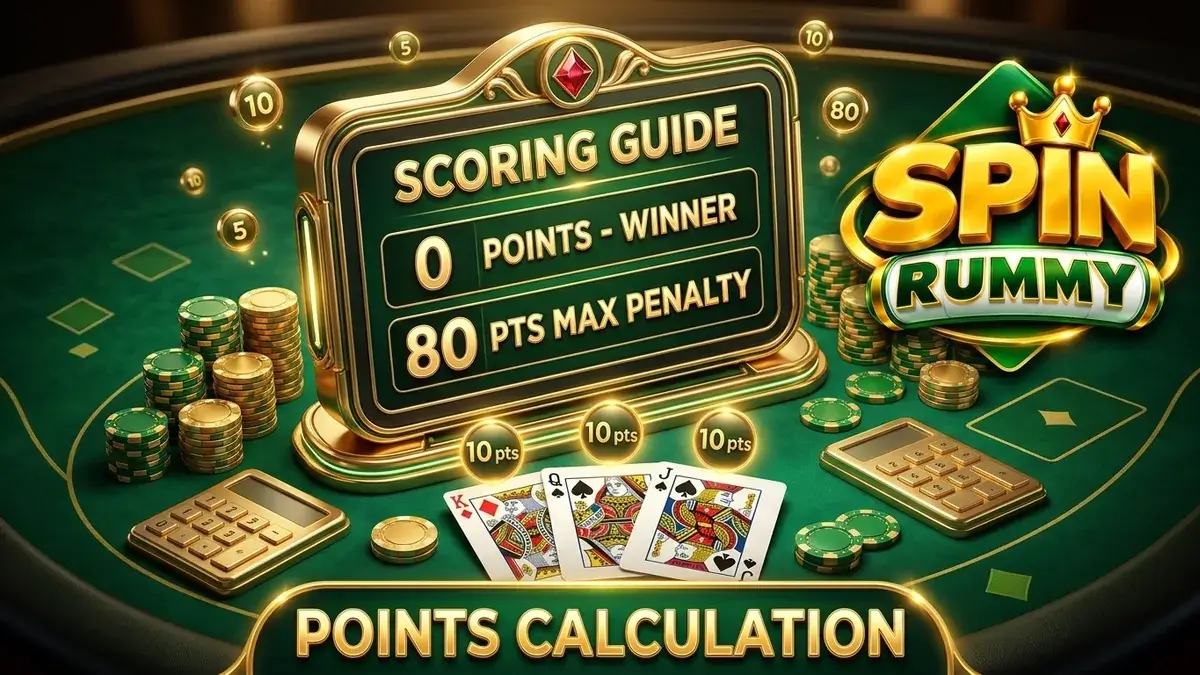
How to Play Spin Rummy point calculation drop rules penalty points and winning declaration
🎰 Ready to Practice 13-Card Rummy Strategy?
Put these 7 winning steps into action on Spin Rummy free practice tables and master pure sequences risk-free.
⚡ Play Spin Rummy Free Now