
How to Play Spin Rummy Guide: 7 Essential Best Winning Tactics (2026)

Description

- 1. Mastering the How to Play Spin Rummy Guide
- 2. The Mathematical Rhythm of 13-Card Gameplay
- 3. 7 Winning Tactics in How to Play Spin Rummy Guide
- 4. Sequence & Set Formation Comparison
- 5. Discard Psychology & Opponent Tracking
- 6. Strategic Drop Evaluation and Point Minimization
- 7. Frequently Asked Questions (FAQ)
🃏 The Expert Card Strategy Playbook
This in-depth How to Play Spin Rummy Guide takes you past simple rules into the mathematical tactics, discard reads, and sequence management needed for consistent table performance.
Mastering the How to Play Spin Rummy Guide
Welcome to our advanced strategic breakdown: the How to Play Spin Rummy Guide. While novice players often view rummy as a matter of luck, seasoned competitors recognize that 13-card Indian rummy is driven by probability calculation, pattern observation, and risk mitigation.
On Spin Rummy, you can put these principles to work across interactive multiplayer tables using virtual practice chips. There is no monetary wagering, no financial risk, and zero deposit friction. It is pure intellectual recreation designed to keep your mind agile and sharp.
As documented in classical card theory on card game tactical principles, observing the sequence of cards entering and leaving play provides vital data regarding opponents’ potential melds.
The Mathematical Rhythm of 13-Card Gameplay
Every match on Spin Rummy follows an elegant mathematical rhythm. Two 52-card decks containing 104 standard cards and printed jokers yield trillions of possible initial distributions.
The master player does not wait passively for perfect cards. Instead, you constantly reconfigure your hand, discarding low-probability combinations and converting multi-way connector cards (such as 7♠-9♠) into robust sequences through calculated draws.
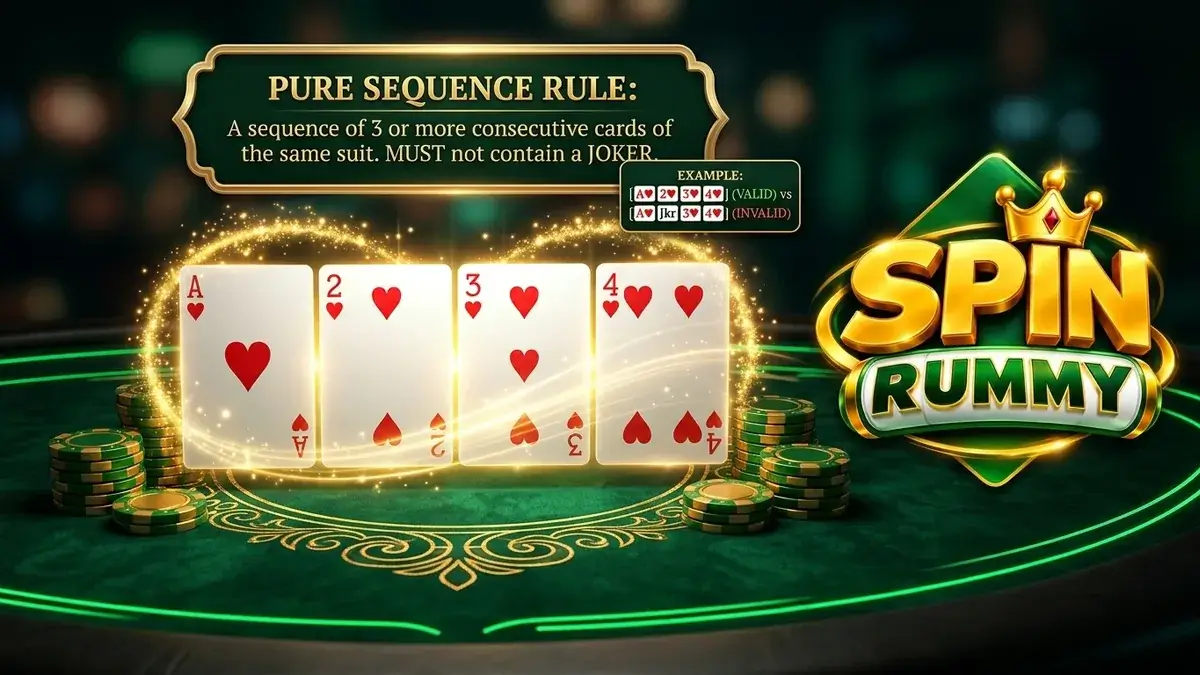
How to Play Spin Rummy Guide card sequence creation and set combinations
7 Winning Tactics in How to Play Spin Rummy Guide
Here are 7 field-tested tactics outlined in our How to Play Spin Rummy Guide to elevate your gameplay:
- Prioritize Pure Runs Over Everything: Without a pure sequence, any secondary sets or impure runs count for zero. Lock in your pure sequence within the first 3 turns.
- Retain Middle Connecting Cards: Cards valued 5 through 9 have double the pairing probability of extreme end cards (Aces and Kings) because they can connect on both sides.
- Bait Opponent Discards: If you hold 6♦ and 8♦, discard a 5♦ or 9♦ from an unrelated hand. Opponents often discard adjacent cards assuming they are safe.
- Track the Discard Pile Constantly: Never pick a card from the open pile unless it directly completes a run. Picking from the open deck reveals your hand intentions to observant opponents.
- Unload High-Point Deadwood: Discard unlinked face cards (K, Q, J) by Turn 3 to cap your potential penalty if an opponent declares early.
- Preserve Jokers for Difficult Sets: Utilize your wild cut jokers to complete 4-card impure sequences or high-point sets (e.g., 10-10-Joker).
- Know When to Take the Drop: An early drop of 20 points preserves your overall leaderboard standing far better than stubborn play that ends in an 80-point defeat.
Sequence & Set Formation Comparison
| Meld Strategy | Primary Objective | Optimal Execution |
|---|---|---|
| Opening Pure Sequence | Establish hand validity | Use connected natural cards (e.g., 7♥-8♥-9♥) |
| Secondary Sequence | Fulfill second declaration requirement | Employ cut joker (e.g., 2♣-3♣-WJ-5♣) |
| Sets & Melds | Zero out remaining deadwood | Combine cards of identical rank across suits |
Discard Psychology & Opponent Tracking
An essential takeaway from our How to Play Spin Rummy Guide is reading the discard tray. If the player on your right picks a 4♣, you should avoid discarding a 3♣, 4♦, or 5♣ for the remainder of the round.
Similarly, observe what opponents discard. If an opponent discards a Queen of Hearts, Kings and Jacks of Hearts are generally safer discards because they are less likely to be assembling a hearts run. Study more tips on Spin Rummy Card Rules.
Strategic Drop Evaluation and Point Minimization
Experienced players know that folding a poor hand is a winning play over a tournament series. In standard Points Rummy, taking a First Drop concedes 20 points, whereas fighting with an unplayable hand frequently yields a catastrophic 80 points.
For complete mathematical tables on drop calculations, explore our detailed guide on Spin Rummy Points Calculation, and avoid bad habits by reading Spin Rummy Mistakes to Avoid.
Frequently Asked Questions (FAQ)
What makes a sequence “pure” in 13-card rummy?
A pure sequence consists of three or more consecutive cards of the exact same suit formed without any wild or printed jokers (e.g., 5♠-6♠-7♠).
Can a set consist of four cards?
Yes! A valid set can contain four cards of the same numerical rank, provided all four cards belong to different suits (e.g., 9♠-9♥-9♦-9♣).
Why should I practice on Spin Rummy free tables?
Free practice tables allow you to master card calculations and discard strategies without monetary risk, building genuine skill and confidence.
Where can I learn more about player account security?
Read our comprehensive overview in the Spin Rummy Safety Guide.

How to Play Spin Rummy Guide score calculation drop rules and valid shows
🎰 Master 13-Card Strategy On Free Tables
Sharpen your memory and analytical sequence skills on Spin Rummy with unlimited practice chips and 100% fair dealing.
⚡ Play Spin Rummy Free NowRelated apps








Developer's apps
-
Recent Posts